DiffusionGemma: Is the Future of AI Reasoning More Transparent Than We Thought?
DiffusionGemma challenges traditional assumptions about AI transparency. This article explores how diffusion-based language models reason, why their thinking process differs from conventional LLMs, and what new research reveals about the future of interpretable artificial intelligence.
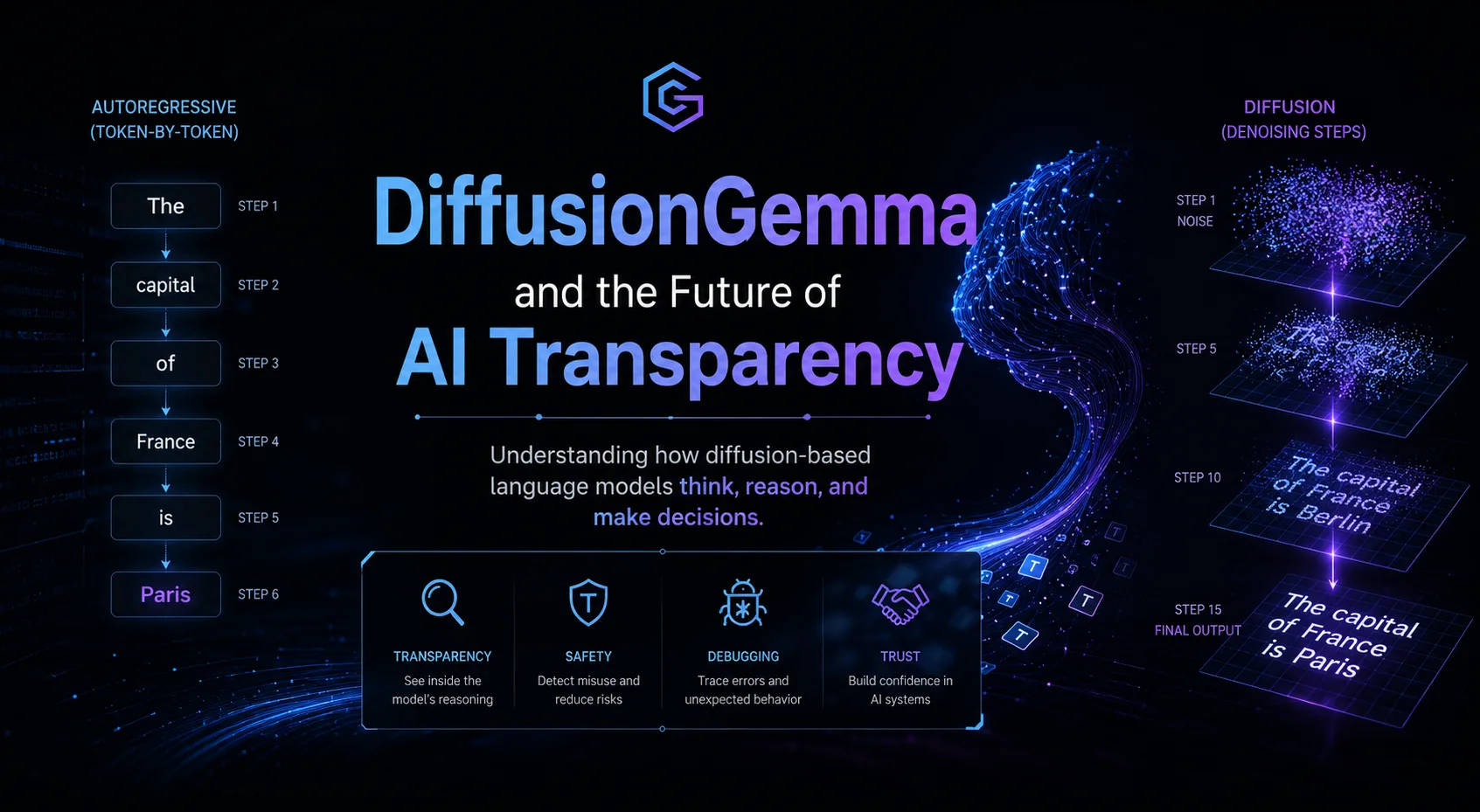
DiffusionGemma and the Future of AI Transparency
Understanding how diffusion-based language models think, reason, and make decisions.
Introduction
As AI systems become more capable, one question is becoming increasingly important:
How does an AI model arrive at its answers?
Understanding a model's reasoning process is essential for improving safety, reducing misuse, debugging unexpected behavior, and building trust in AI systems.
Traditional language models such as GPT and Gemma generate text one token at a time. This makes their reasoning process relatively easy to follow.
However, a new class of models, known as diffusion language models, takes a very different approach.
One of the most interesting examples is DiffusionGemma.
Unlike conventional language models, DiffusionGemma generates text by gradually refining an entire sequence through multiple denoising steps rather than producing words one after another.
This naturally raises an important question:
Does performing more computation in a hidden latent space make diffusion models less transparent?
Recent research explores exactly this question.
Autoregressive vs Diffusion Language Models
Traditional Language Models
Most modern LLMs generate text sequentially:
The → capital → of → France → is → ParisEach new token depends on the previous ones.
Because the process unfolds step-by-step, it is relatively straightforward to inspect and analyze.
Diffusion Language Models
Diffusion models work differently.
Instead of generating text from left to right, they start with noisy predictions and repeatedly refine them.
Step 1:
???? ????? ????

Step 5:
The capital ??? ???

Step 10:
The capital of France is Berlin

Step 15:
The capital of France is Paris
At every step, any part of the sentence can change.
This flexibility makes diffusion models powerful while also making them harder to interpret.
Two Types of Transparency
Researchers divide transparency into two key categories.
Variable Transparency
Variable transparency asks:
Can we understand the model's intermediate states?
In simple terms, can we inspect what the model is doing while it is still generating an answer?
Algorithmic Transparency
Algorithmic transparency asks:
Can we reconstruct the reasoning process from those intermediate states?
This is a much harder challenge because understanding a snapshot is not the same as understanding the complete algorithm.
Why DiffusionGemma Initially Appears Opaque
Researchers introduced a metric called Opaque Serial Depth.
This measures how much hidden computation occurs between interpretable states.
Initial findings suggested:
Gemma 4          : █
DiffusionGemma   : ████████████████████████████

≈ 28.6× More Hidden Computation
At first glance, DiffusionGemma appeared dramatically less transparent than its autoregressive counterpart.
The Breakthrough: Interpretable Token Bottlenecks
To investigate further, researchers introduced an interpretable token bottleneck.
The idea is simple:
Latent State
      ↓
Interpretable Tokens
      ↓
Next Denoising Step
Instead of keeping information hidden in latent representations, the model passes through a readable token layer.
Surprisingly, this change produced:
- No noticeable drop in performance
- No loss in downstream accuracy
- Significantly improved transparency
Results
Before : 28.6× Hidden Computation

After  : 1.1× Hidden Computation
Visual comparison:
Opaque Serial Depth

30 ┤
25 ┤ ████████████████████████
20 ┤
15 ┤
10 ┤
 5 ┤
 1 ┤ █
 0 └─────────────────────────
      Gemma   Diffusion*
              (Improved)
This finding challenges the assumption that diffusion language models are inherently opaque.
New Forms of Reasoning
One of the most fascinating aspects of the study was the discovery of reasoning patterns rarely seen in autoregressive models.
1. Non-Chronological Reasoning
Traditional models reason sequentially:
Step 1
Step 2
Step 3
Step 4
Diffusion models can reason in a less linear fashion:
Step 4
Step 2
Step 1
Step 3
Different parts of the answer may emerge simultaneously rather than in a fixed order.
2. Token Smearing
In autoregressive models, information is often associated with a specific token.
Example:
ParisIn diffusion models, information may be distributed across multiple tokens and gradually consolidated.
Researchers refer to this phenomenon as token smearing.
3. Sequence Smearing
Information can also spread across an entire sequence.
Token 1 → Partial clue
Token 2 → Partial clue
Token 3 → Partial clue
Token 4 → Final meaning
Meaning is not necessarily localized and may emerge collectively.
4. Intermediate-Context Reasoning
Diffusion models appear capable of reasoning using their own intermediate states.
Step 3
   ↓
Step 7
   ↓
Step 11
Earlier denoising stages can influence later reasoning stages.
Why Transparency Matters
Transparency is not merely an academic concern.
It directly impacts:
AI Safety
Understanding reasoning helps identify harmful or unintended behavior.
Alignment
Researchers can verify whether models are pursuing intended objectives.
Debugging
Developers can trace how incorrect outputs are produced.
Trust
Users and organizations gain greater confidence in AI systems when their behavior can be inspected.
Testing Monitorability
Researchers also evaluated monitorability.
Monitorability asks:
Are the model's intermediate outputs useful for monitoring and oversight?
The results were surprisingly positive.
Gemma 4         ███████████
DiffusionGemma  ██████████
Despite architectural differences, DiffusionGemma proved nearly as monitorable as Gemma 4.
This suggests that diffusion-based language models may remain practical for safety and oversight applications.
Conceptual Architecture
Random Noise
      ↓
Denoising Step 1
      ↓
Denoising Step 2
      ↓
Denoising Step 3
      ↓
Interpretable Tokens
      ↓
Reasoning Analysis
      ↓
Final Output
Simple Demonstration
The following example illustrates iterative refinement:
steps = [
    "???? ????? ?????",
    "The ????? of ?????",
    "The capital of ?????",
    "The capital of France is ?????",
    "The capital of France is Paris"
]

for i, step in enumerate(steps, start=1):
    print(f"Step {i}: {step}")
Output:
Step 1: ???? ????? ?????
Step 2: The ????? of ?????
Step 3: The capital of ?????
Step 4: The capital of France is ?????
Step 5: The capital of France is Paris
Key Takeaways
- Diffusion language models are not necessarily as opaque as they first appear.
- Interpretable token bottlenecks can dramatically improve transparency.
- Diffusion models exhibit reasoning patterns that differ from traditional LLMs.
- Non-chronological reasoning may be a real capability of diffusion architectures.
- Information can be distributed across tokens and sequences.
- Monitorability remains comparable to autoregressive models.
Conclusion
The future of AI is not only about building more powerful models but also about understanding them.
DiffusionGemma demonstrates that advanced language models may reason in ways fundamentally different from the token-by-token approach used today.
Their reasoning appears more distributed, parallel, and dynamic.
As AI architectures evolve, our methods for understanding them must evolve as well.
DiffusionGemma offers an early glimpse into a future where transparency is no longer about reading generated words, but about uncovering the hidden processes that shape them.
Pantheraa Space is an India-based digital marketing & development agency. We build websites and custom software, run Google & Meta Ads, and grow your visibility with SEO, Google Business Profile and AI search optimization (AIO).
Want this done for your business?
Get a free audit